Source indoor artificial palm tree for Home, Office, Supermarket
Find and compare 24 indoor artificial palm tree options from verified suppliers. Buyers can review specifications, pricing, and lead times for models suitable for home, office, and commercial spaces.
Key considerations
Products List


Comprehensive Sourcing Guide
Strategic Sourcing Guide for Indoor Artificial Palm Trees
Understanding Product Variants and Technical Specifications
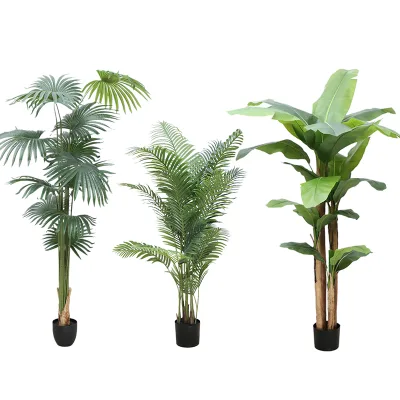
The market for indoor artificial palm trees presents a diverse array of options, ranging from standalone decorative units to potted installations designed for commercial spaces. Buyers must first distinguish between the specific product models available, as technical specifications vary significantly across listings. The core product category includes items identified as "Artificial Tree," "Artificial Plant," and specifically "Artificial Washington Palm Tree." These variations often dictate the structural requirements and intended use cases.
A critical technical differentiator is the height and standard dimensions of the units. Observed product standards indicate a wide range of available sizes, including specific measurements such as 2 meters, 3 to 6 meters, and a detailed list of 60, 90, 120, 150, 180, 210, and 240 centimeters. Some models are specified as 80cm, 110cm, 130cm, 150cm, or 180cm, while others are categorized by a general standard of 5 meters. This variance requires buyers to align their spatial constraints with the product's physical dimensions before proceeding with procurement.
Material composition is another fundamental specification. The primary material cited for these artificial palms is plastic, which influences the texture, durability, and visual realism of the foliage. The production process is predominantly described as "Handmade," suggesting a higher level of attention to detail in leaf arrangement and stem construction compared to fully automated mass production. This manual assembly can impact the consistency of the final product, making it essential for buyers to request samples to verify the quality of the handiwork.
The following table summarizes the observed technical specifications and product attributes to assist in initial filtering:
| Attribute Category | Observed Specifications |
|---|---|
| Product Models | Palm Tree, Artificial Tree, Artificial Potted Plant, XGJYZK-035-08001, TZK-060-16001 |
| Height Standards | 2m, 3-6m, 60-240cm (specific steps), 5m |
| Material | Plastic |
| Production Process | Handmade |
| Weight | 25kg per tree, 15kg per meter |
| Color | Green |
| Surface Treatment | Printing (for logos) |
Compliance, Safety, and Certification Verification
When sourcing artificial greenery for indoor environments, particularly in public or commercial spaces like hotels, airports, and supermarkets, compliance with safety standards is paramount. A specific attribute observed in the product data indicates that certain units are "Non-fire Retardant." This is a critical finding for procurement teams, as many jurisdictions and building codes require interior decorations to meet specific fire safety ratings.
Buyers must not assume that all listed artificial palm trees possess fire-retardant properties. The presence of a "Non-fire Retardant" label on some models necessitates a rigorous verification process. Procurement officers should explicitly request fire resistance test reports or certification documents from potential suppliers before placing orders for large-scale deployments. Relying on the default "Non-fire Retardant" status could lead to compliance failures during safety inspections or insurance audits.
Furthermore, while the product data mentions "Eco-Friendly" as a feature, this term is not a certified standard in itself. Buyers should verify what specific environmental claims are being made. Does the plastic material utilize recycled content? Is the manufacturing process energy-efficient? Without specific certification data, these claims should be treated as marketing observations rather than verified performance metrics. The absence of explicit certification names in the provided data means that the buyer must initiate the inquiry to confirm if the supplier holds relevant environmental or safety certifications.
Cost Drivers and Pricing Dynamics
The pricing structure for indoor artificial palm trees is influenced by several variables, including size, customization, and packaging complexity. The observed price range in the market spans from $4.79 to $1,442.30 USD. This wide disparity is primarily driven by the height and weight of the unit. For instance, a 2-meter tree will naturally cost significantly less than a 5-meter or 6-meter unit, which requires more material and structural reinforcement.
Weight is a direct cost driver. The data indicates weights of 25kg per tree or 15kg per meter. Heavier units require more robust iron frames and more substantial packaging to prevent damage during transit. The packaging specifications vary from "1PCS/Bubble Bag with Iron Frame" to "Carton" or "Boxed" configurations. A unit packed in a single bubble bag with a frame is likely a smaller, lighter item, whereas a large tree shipped in a carton with multiple units (e.g., "4PCS in One Carton") implies a different logistical cost structure.
Customization is another significant factor affecting the final price. The data confirms that customization is available and that logo printing options exist, ranging from "Without Logo Printing" to "With Logo Printing" using surface treatment printing. Adding custom logos or specific color variations will increase the unit cost and potentially extend the lead time. Buyers should anticipate that the base price of a standard green palm tree will be lower than a customized version with branding.
Typical Applications and Suitability Analysis
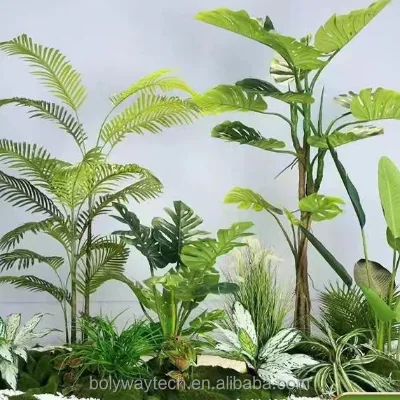
The versatility of artificial palm trees makes them suitable for a broad spectrum of environments. The product attributes explicitly list suitability for "Home," "Office," "Supermarket," "Garden," "Restaurant," "Hotel," and "Airport." This wide applicability suggests that the product line is designed to meet both residential aesthetic needs and commercial durability requirements.
For residential use, the focus is often on decoration and style. The "Artificial Tree" and "Artificial Plant" styles are marketed for home decoration, where the visual appeal and the "Green" color are the primary selling points. In commercial settings like hotels and airports, the requirements shift towards durability and safety. The "Handmade" process and the availability of iron frames suggest that these units are built to withstand foot traffic and maintain their shape over time.
The "Eco-Friendly" feature, while unverified, may be a selling point for businesses aiming to reduce water usage or maintenance costs associated with real plants. However, the suitability for outdoor "Garden" use should be carefully evaluated against the material properties. Since the material is plastic and some units are non-fire retardant, buyers must ensure the specific model is rated for the intended environment, especially if it will be exposed to direct sunlight or varying weather conditions, even if marketed for indoor use.
Supplier Evaluation and Operational Logistics
Evaluating suppliers for artificial palm trees requires a focus on operational capabilities and logistical reliability. The origin of the products is consistently listed as "China," with specific mentions of "Guangdong" and "Guangdong Heyuan." These regions are known for manufacturing capabilities, but buyers should verify the specific factory location to ensure it aligns with their supply chain preferences.
Lead times are a critical operational metric. The observed data shows a range of delivery windows, including "15-20 Days," "10-25 Days," and "7-15 Days." This variation indicates that lead times are not fixed and likely depend on the order volume, customization requirements, and the specific production schedule of the supplier. Buyers must clarify the exact lead time for their specific order before committing to a purchase date to avoid delays in project timelines.
Payment terms are another area requiring attention. The data lists both "Paypal" and "T/T" (Telegraphic Transfer) as accepted payment methods. For large B2B transactions, T/T is the standard, but the availability of PayPal suggests flexibility for smaller orders or individual buyers. Buyers should confirm which payment method is applicable to their order size and negotiate terms that protect their financial interests.
The Minimum Order Quantity (MOQ) also varies, with observed values ranging from 1 piece to 500 pieces, and specific mentions of "4 PCS" or "2 Meter" as minimums. This flexibility allows buyers to test the market with small orders or scale up for bulk procurement. However, buyers should be aware that lower MOQs might come with higher per-unit costs, while larger orders may qualify for volume discounts.
Quality Control and Long-Term Procurement Considerations
Ensuring consistent quality is essential for long-term procurement success. Given that the production process is "Handmade," there is an inherent risk of variation between units. To mitigate this, buyers should implement a rigorous quality control protocol. This includes requesting pre-shipment photos or videos of the actual production batch, not just generic product images.
The packaging specifications, such as "4PCS in One Carton" or "1PCS/Bubble Bag with Iron Frame," play a vital role in maintaining product integrity during shipping. Buyers should verify that the packaging is robust enough to protect the plastic leaves and iron frames from crushing or bending. For heavy units, the structural integrity of the carton and the securing of the iron frame are critical to prevent damage upon arrival.
Long-term considerations also involve the lifespan of the product. One attribute lists a "Life Time" of "10 Years." While this is a positive indicator of durability, buyers should understand the conditions under which this lifespan is achieved. Exposure to UV light, heat, or physical stress can degrade plastic materials over time. Buyers should inquire about the UV stability of the plastic and the maintenance requirements to ensure the product retains its appearance for the expected duration.
Finally, the availability of spare parts or replacement components should be considered. If a leaf or branch is damaged, can it be easily replaced? The "Handmade" nature of the product suggests that custom repairs might be necessary, so establishing a relationship with a supplier who can provide support or replacement parts is a strategic advantage for long-term procurement. By focusing on these quality and logistical factors, buyers can secure a reliable supply of indoor artificial palm trees that meet their aesthetic and functional requirements.
FAQs
What are the typical lead times for indoor artificial palm trees?
Lead times typically range from 7 to 25 days depending on the specific order and customization. Some suppliers offer delivery within 7 to 15 days, while others require 10 to 25 days or 15 to 20 days for production and shipping.
Which payment methods are accepted for purchasing these trees?
Suppliers commonly accept T/T and PayPal as payment methods for these transactions. Buyers should confirm the specific terms with the vendor, as options may vary based on order size and negotiation.
How much does an indoor artificial palm tree weigh per unit?
Weight varies by model, with some trees weighing 25kg per unit and others at 15kg per meter. Heavier units often require iron frames and robust packaging to ensure safe transit.
Can I customize the palm trees with my company logo?
Yes, customization is available including logo printing with surface treatment. Some options allow for logo printing while others are supplied without it, depending on the specific product model selected.
What is the minimum order quantity for indoor artificial palm trees?
Minimum order quantities range from 1 piece to 500 pieces depending on the supplier. Specific listings may require a minimum of 2 meters or 4 pieces for certain product models.
Are these artificial palm trees fire retardant for indoor use?
Some listed units are explicitly marked as non-fire retardant, which is critical for safety compliance. Buyers must verify fire resistance certifications before purchasing for commercial spaces like hotels or airports.
Where are these indoor artificial palm trees manufactured?
Products originate from China, with specific manufacturing hubs in Guangdong and Guangdong Heyuan. Buyers should verify the exact factory location to align with their supply chain preferences.